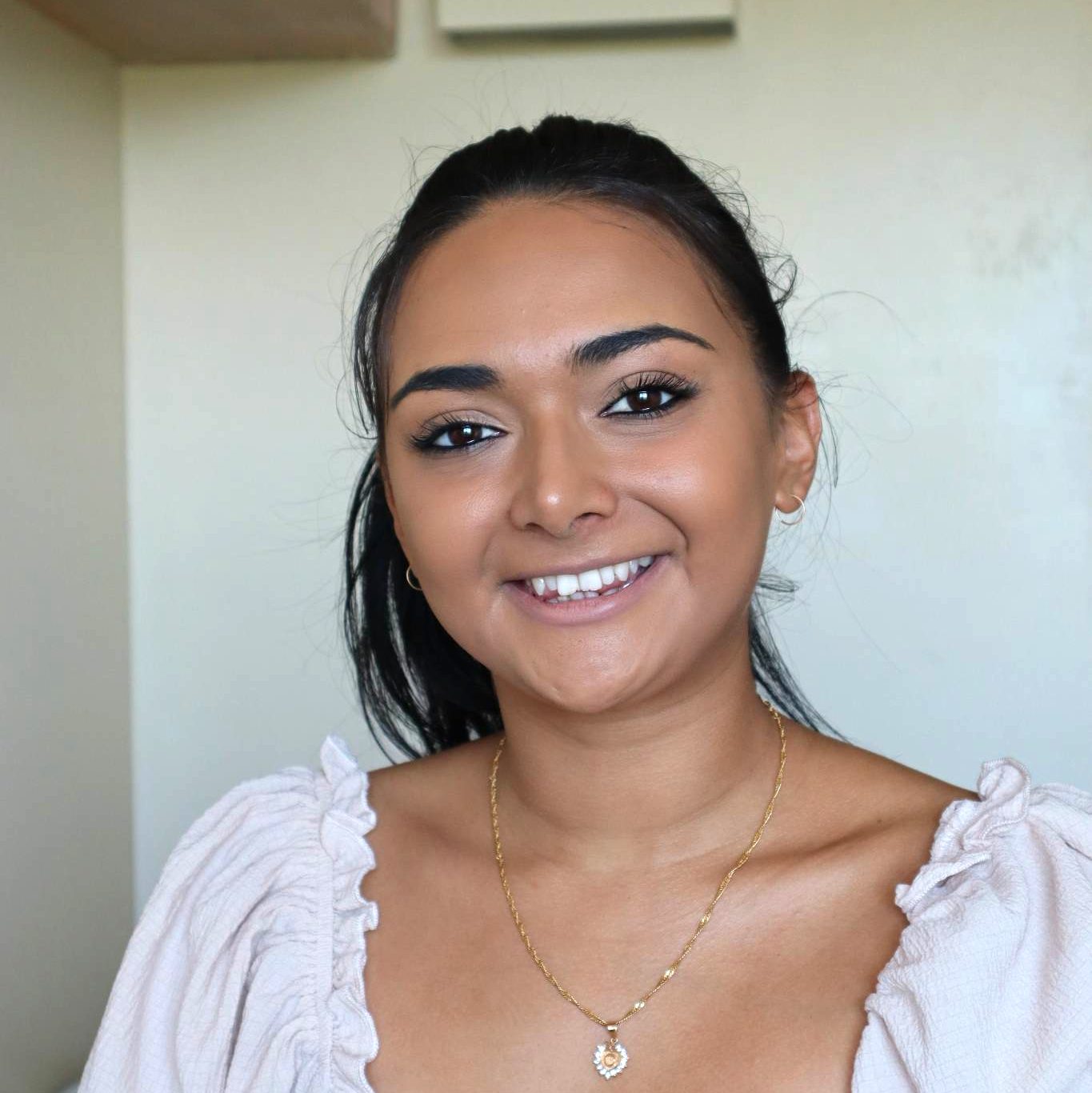
Carissa Chew is a doctoral researcher in History at the University of Edinburgh, who also works as a professional speaker and Inclusive Metadata Consultant in the UK heritage sector.
Carissa’s research seeks to recover mixed-race experiences using the framework of World History. Being of mixed Bengali and English heritage, this undertheorised area of history lies close to her heart. Carissa’s primary focus is East Africa, and her PhD research uses oral history to explore the the identities of people of mixed Black and South Asian heritage in Tanzania, Kenya, and Uganda in the period 1940-1980.
Interests: East Africa, Mixed-Race Studies, Indian Ocean, South Asian Diaspora, World History, British Empire
Qualifications: BA Edinburgh 2019, MPhil Cambridge 2020, MA Hawaiʻi at Mānoa 2024
Email: Carissa.Chew@ed.ac.uk
Supervisors: Dr. Emma Hunter, Dr. Sara Dorman, Dr. Rochelle Rowe
PhD Project
Carissa’s thesis centres the perspectives of people of mixed Black and South Asian heritage in Tanzania, Kenya, and Uganda in the late colonial and early postcolonial period (1940-1980). People of mixed Black/South Asian heritage in East Africa have faced multi-directional marginalisation both historically and historiographically, meaning their voices have rarely been recorded across written archives. Collecting oral histories and archival sources from across Nairobi, Dar es Salaam, and Kampala, Carissa explores how they navigated a rigid monoracial hierarchy in a period of rising African nationalisms. She asks questions about how they formulated their own identities and where they fit into public and political debates surrounding diaspora, nationhood, citizenship, and belonging. Under British colonial rule in Tanganyika, Kenya, and Uganda alike, a person was racially classified as either “European”, “Asian”, or “African”. Legally speaking, there was no in-between. Such a rigid racial classification system continued to shape social, political, and legal status under Tanzania, Kenya, and Uganda’s new postcolonial regimes. How, then, did mixed-race people fit into the tripartite racial society?
Background
After graduating with a first class BA in English Literature and History from the University of Edinburgh in 2019, Carissa completed an MPhil in World History at the University of Cambridge in 2020. From September 2020 to June 2021, Carissa worked as the Equalities, Diversity, and Inclusion Intern at the National Library of Scotland before moving to Hawaiʻi in August 2021 to begin a PhD in History. After three years in the taught portion of the History PhD program at the University of Hawaiʻi at Mānoa, where she also worked as a Graduate Teaching Assistant (2021-24) and served as the President of Phi Alpha Theta National History Honor Society (2023-24), she decided to transfer out with an MA in History and return to the University of Edinburgh to conduct her PhD research closer to home. Alongside her studies she has completed inclusive cataloguing projects with various heritage organisations, including the Imperial War Museums, Glasgow School of Art Library, People’s Collection Wales, and V&A Museum.
Research interests
Carissa’s academic approach is inspired by postcolonial literature, “history from below” perspectives, oral history methodologies, Indigenous feminisms, and critical race theory. She is particularly interested in the construction of racial categories and the study of British colonial legacies, with an emphasis on how mixed-race people have negotiated their own identities. Geographically, her main focus has been East Africa, South Asia, and the British Empire. Whilst living in Hawaiʻi, she developed increased interest in the social and cultural landscapes of the Pacific region too.
Blog
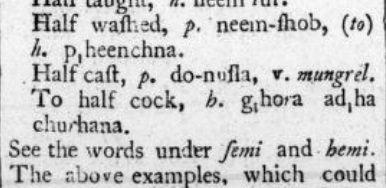
Carissa writes blog posts related to academia, heritage, and her research. These are available open access via Medium.



Heritage sector
Whilst working with the National Library of Scotland, Carissa founded two projects within the field of critical cataloguing. The first of these is the Inclusive Terminology Glossary (or Chew Glossary), a wiki that provides guidance for heritage professionals on discriminatory and harmful language relating to race, ethnicity, gender, sexuality, religion, and disability. The second of these is the Cultural Heritage Terminology Network (CHTNUK), an online platform that promotes cross-institutional collaboration on inclusive description issues and also hosts resources for the UK Heritage X Palestine Action Group. Carissa is committed to the decolonisation of language and metadata in the UK heritage sector and currently offers consultancy services.
Publications
Chew, Carissa. “[Book Review] Colonising Disability: Impairment and Otherness Across Britain and Its Empire, c. 1800–1914. Esme Cleall, Cambridge, Cambridge University Press, 2022, 310pp., ISBN 9781108833912 (hbk, £75).” Journal of Imperial and Commonwealth History 53, no.1 (2024): 199-202. https://doi.org/10.1080/03086534.2024.2445735.
Chew, Carissa. “Inclusive terminology for the heritage sector.” ICOM-IMREC: Museums, Decolonisation, and Restitution: A Global Conversation (2024): 97-105. https://aus.zxhsd.com/kgsm/ts/2024/06/25/6326886.shtml.
Chew, Carissa. “Inclusive description in the Glasgow School of Art Library’s published catalog.” Collections: A Journal for Archives and Museum Professionals 20, no.1(2024): 1-13. https://doi.org/10.1177/15501906241232307.
Chew, Carissa. “Music and misrepresentation: guidance on dealing with harmful materials and discriminatory language in music collections.” Brio 60, no.1 (2023): 38-43. https://iaml-uk-irl.org/media/Brio_60_1_2023.pdf.
Chew, Carissa. “Decolonising description: addressing discriminatory language in Scottish heritage and beyond.” Journal of Irish and Scottish Studies 11, no.1 (2023): 1-18. doi.org/10.57132/jiss.213.
Chew, Carissa. “The Ant as Metaphor: Orientalism, Imperialism and Myrmecology.” Archives of Natural History 46, no.2 (October 2019): 347-361. doi.org/10.3366/anh.2019.0595.
Awards
William R. McFarlane Scholarship in Global History, University of Edinburgh, 2024-2027.
Tweedie Research Fellowship, University of Edinburgh, January 2026.
Postgraduate Research Support Grant, Royal Historical Society, July 2025.
Best Paper Prize: South Asia, School of Pacific & Asian Studies (SPAS), 35th Annual SPAS Graduate Conference, University of Hawaiʻi, April 2024.
Walter Vella Prize & Honorary Mention for Best Graduate Paper, Phi Alpha Theta History Honor Society, 40th Annual Hawaiʻi Regional Meeting of Phi Alpha Theta, March 2024.
Research Corporation of the University of Hawaiʻi Graduate Fellowship Fund, 2023-2024.
Best Graduate Paper Prize & Jerry H. Bentley Paper Prize for World History, Phi Alpha Theta History Honor Society, 39th Annual Hawaiʻi Regional Meeting of Phi Alpha Theta, April 2023.
Library Treasures Award, University of Hawaiʻi at Mānoa Library, Summer 2022.
Jerry H. Bentley Endowed Scholarship in World History, University of Hawaiʻi at Mānoa, 2022-2023.
Jagdish P. Sharma Memorial Scholarship in South Asian Studies, University of Hawaiʻi at Mānoa, 2022-2023.
Annabella Kirkpatrick Prize for Undergraduate History Dissertation, University of Edinburgh, 2019.
William T. Stearn Student Essay Prize, Society for the History of Natural History, 2018.
Margaret Balfour Keith Prize for Asian and African History, University of Edinburgh, 2017.
Carissa Chew 2024©
 Carissa Chew